Idea to Live Product
Three CTOs walked away from it. We shipped the POC of an AI analytics platform in 2 weeks.
Three CTOs tried to build this. All of them got stuck on the same thing: making sense of unstructured AI responses across three engines. We shipped the POC in two weeks.

One team. Research to live product.
The founder tried three CTOs. All got stuck on the core problem: AI engines don't return structured data. Every response is different. Making that parseable, scoreable, and actionable at the product level across three engines didn't exist yet.
- Service
- MVP Development
- Industry
- SaaS
- Client type
- Startup founder
- Duration
- 2 weeks to POC
Customer discovery across 50+ Shopify stores and agencies
Full-stack product build: Next.js, Supabase, AI integrations across 3 engines
AI doesn't rank pages. It compares products. Nobody had tools for that.
Every Shopify store we talked to had the same blind spot. They optimized for Google. They had no idea what ChatGPT or Perplexity says about their products. AI doesn't rank pages. It compares products in real time, and the answer changes with every prompt. No existing tool could track that.
- 01
AI responses aren't structured data.
Each engine returns different formats. Extracting consistent product-level signals from ChatGPT, Perplexity, and Gemini required building a custom parsing layer from scratch.
- 02
No benchmarks exist.
There's no PageRank for AI recommendations. We had to define what visibility, share of voice, and sentiment mean in a world where the answer changes with every prompt.
- 03
Competitors stop at analytics.
GEO assist fetches how AI sees you compared to competitors at the product level, then generates optimized descriptions and updates them on the fly. Analytics alone doesn't fix the problem.
- 04
10% of products drive 80% of revenue.
Most stores we analyzed had near-empty descriptions on those high-value items. The platform had to identify which products matter most and prioritize them.
50+ interviews. 2-week POC. Live product.
We didn't start with architecture diagrams. We started with Shopify stores. What do they know about AI? Nothing. What do their product descriptions look like? Empty. That told us what to build and how fast to move.
50+ calls with Shopify stores and agencies. Same pattern everywhere: two-sentence product descriptions, zero awareness of AI recommendations, and no tools to measure it. The problem was validated before we wrote a line of code.
Built the core pipeline: Shopify sync, multi-engine prompt execution, response parsing, visibility scoring. The founder had tried three CTOs before us. We had a working product in his hands in 14 days.
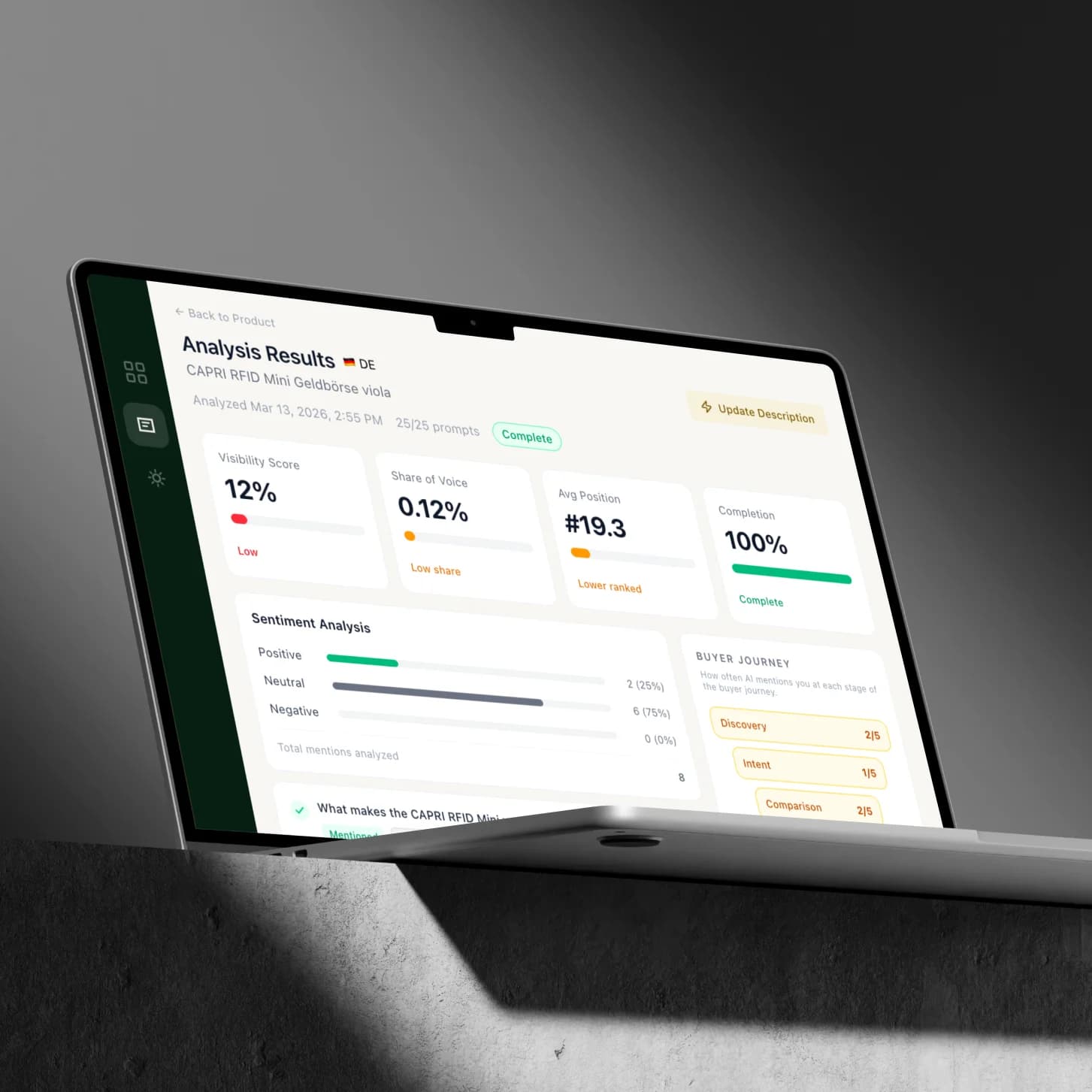
No off-the-shelf analytics existed for this. We defined visibility score, share of voice, sentiment, competitor landscape, and mention position from first principles. All calculated per product, per AI engine, per prompt category. Product-level signals that tie directly to revenue.
Analytics tells you the problem. Descriptions fix it. GEO Assist generates optimized product copy based on what AI engines actually reward. Update your Shopify listing, rerun the analysis, measure the lift. Closed loop.
50+ Shopify stores had no idea if AI recommends them. Now they do.
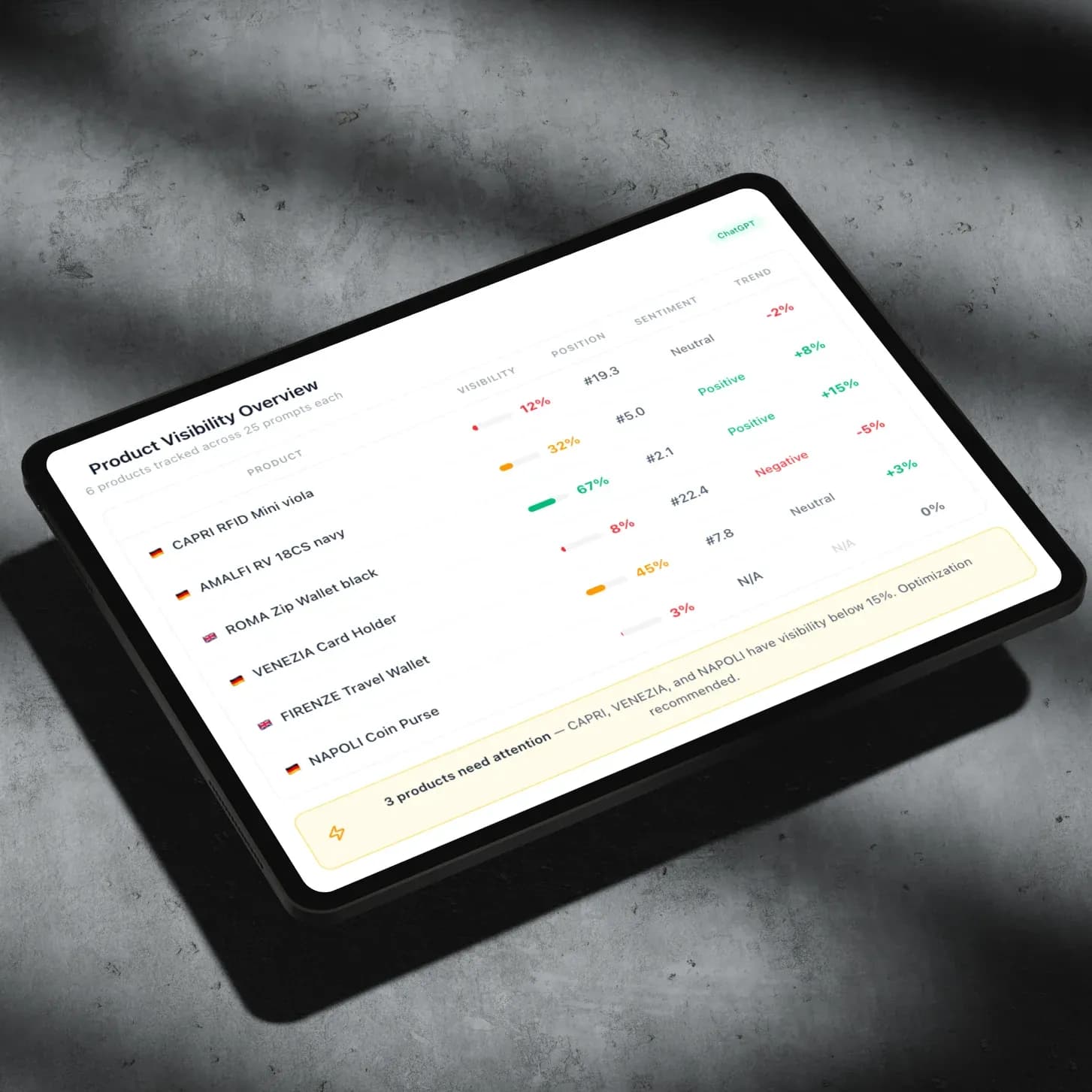
Product-level AI visibility for Shopify
Pick any product. See how ChatGPT, Perplexity, and Gemini talk about it. Who they recommend instead. Where your content falls short. Scored, categorized, actionable.
From empty descriptions to optimized copy
Most stores had two-sentence product descriptions. GEO Assist generates content that closes the gaps AI flagged. Stores update their listings and track the change in visibility over time.
Agency traction from day one
Agencies managing 100+ Shopify stores reached out within the first week. The platform scales across entire portfolios, not just individual shops.